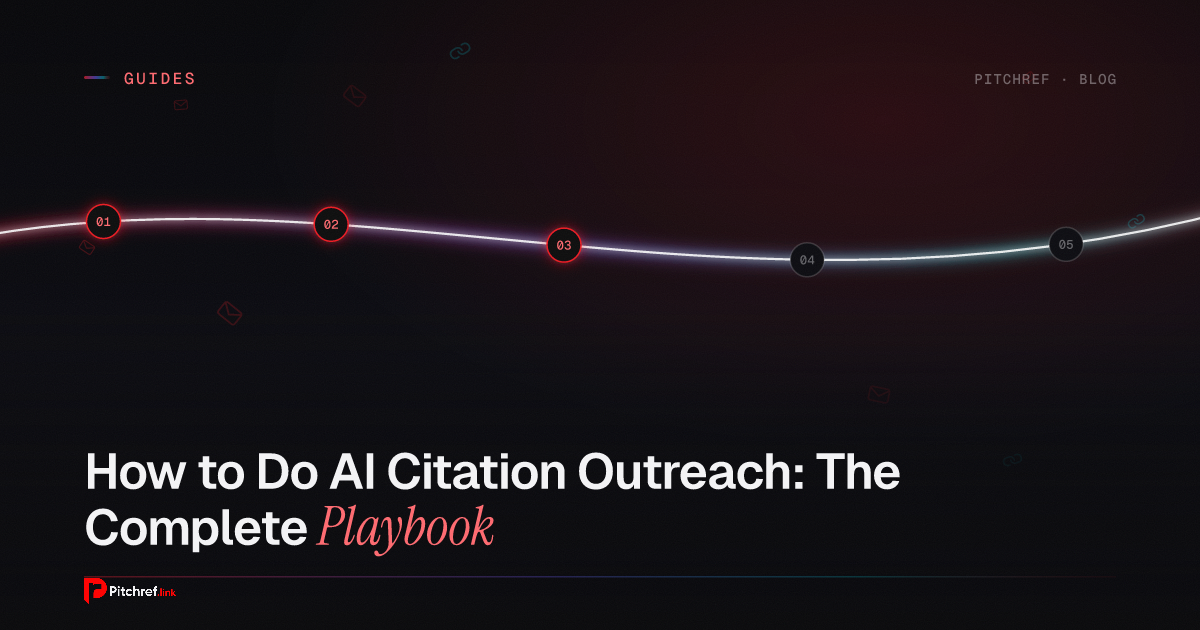
How to Do AI Citation Outreach: The Complete Playbook
The end-to-end operating manual for winning AI citations. Map the pages engines already cite, send pitches that get answered, and close inclusions with follow-ups.
On this page
If you're new to the why, start with What Is GEO?. This post is the how. It's the process we built Pitchref around, and it works whether you run it by hand or let the agent do the heavy lifting.
Step 1: Map the answers you want to be in
List the prompts your buyers actually ask an AI engine. Not keywords. Questions. "Best outreach tools for agencies." "How do I get my SaaS reviewed?" For each, collect the sources the engines cite. Patterns emerge fast: the same listicles, review sites, and comparison posts show up again and again.
That recurring set is your target map. It's usually far smaller than a classic SEO keyword universe. Dozens to a few hundred pages, not tens of thousands.
Step 2: Qualify hard, early
Not every cited page is a winnable target. Kill the dead ends before you spend effort:
- Social threads and forums. Reddit and Quora get cited, but you can't pitch your way into them credibly. Skip.
- Directories with pay-to-play forms. A known price list isn't outreach; handle those separately with a budget decision.
- Blog posts, listicles, reviews, roundups. These are the sweet spot. A human editor owns them, and humans answer email.
Focus every subsequent step on that last group. (This is exactly the filter Pitchref's step-01 "Qualify" runs, and why it exists: unlikely prospects cost the same outreach effort as likely ones and return nothing.)
Step 3: Find the human
For every target page you need the person who can edit it: author, editor, or site owner. Bulk contact extraction gets you most of the way. A well-built extractor finds a usable address on the large majority of blog-style pages without burning tokens or credits on each one. The remainder need manual digging or a contact form. Decide per prospect whether the page's citation value justifies it.
Step 4: Decide the ask, per prospect
There are only three honest asks in citation outreach:
- Free inclusion. "Your list of X is missing us; here's exactly why we fit." Works when you genuinely belong on the list and can prove it in two sentences.
- Paid inclusion. Many established listicles sell placements. If the page is cited often enough, a placement can be worth it. Ask for the price. Negotiate.
- Both, staged. Open with the free case, keep budget in reserve for the targets that matter most.
Set this per prospect before writing, and let your budget shape the mix. A campaign that's all paid-asks burns money. All free-asks leaves your best targets unwon.
Step 5: Write pitches that get answered
The pitch is thirty seconds of the editor's life. Respect that:
- Prove you read the page. Name the section your suggestion belongs in.
- Make the edit trivial. Provide the exact sentence or entry they could paste in.
- Say who you are in one line, with a link that lets them verify fast.
- No attachments, no essays, no flattery paragraphs.
Write like a helpful reader, not a marketer. The follow-up cadence matters more than pitch perfection: a polite nudge at +3 days, +7, +14, and stop the moment they reply. Auto-cancel-on-reply is table stakes. Nothing torches goodwill like a follow-up after a "no thanks".
Step 6: Negotiate and close
Replies split into: yes, yes-if, how-much, and no. The "yes-if" and "how-much" conversations are where citations are actually won. Be ready with your one-paste entry, your budget ceiling, and a fast yes or no. Editors respect speed.
Step 7: Track what compounds
Log every inclusion won: the page, the date, the ask that worked. Watch your citation share on your mapped prompts. Inclusions typically show up in answers as engines refresh their view of the corpus. What you learn feeds the next campaign's targeting. The minimal GEO stack covers the tooling. You need less than you think.
Run it by hand, or don't
Every step above is doable manually. It's also exactly the kind of repetitive, judgment-sprinkled work that eats weeks. Our answer is an agent that runs the whole loop: qualify, extract, pitch, follow up, escalate the conversations that need a human. On your own cloud, for free. And if outreach for backlinks is also on your roadmap, the same muscle applies. See what still works in link building.