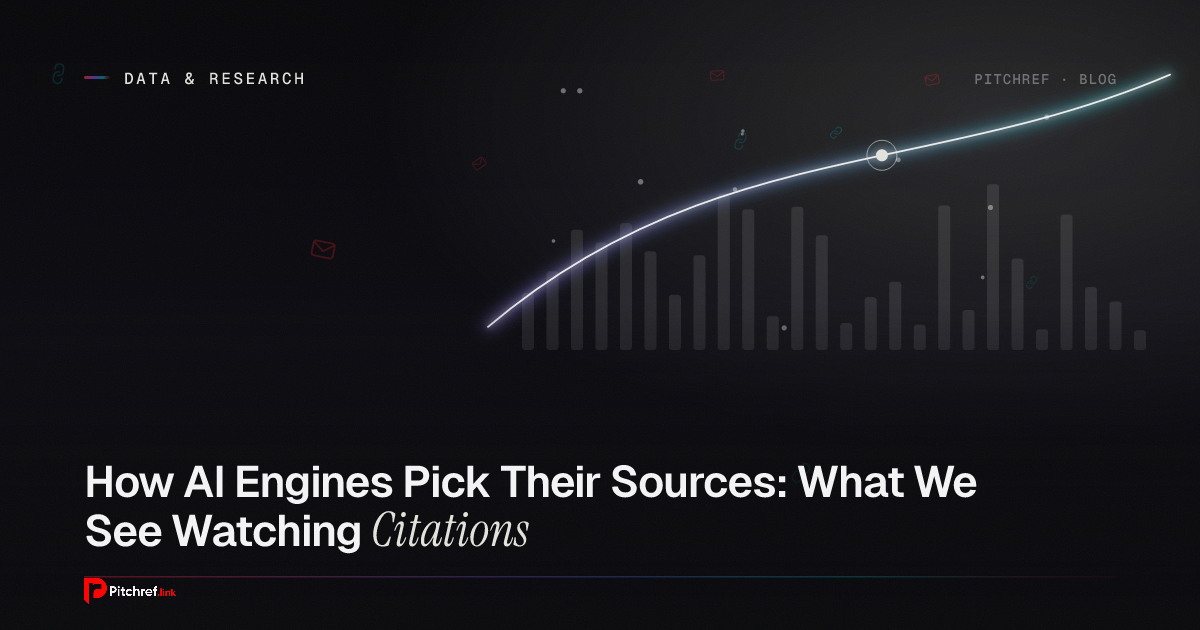
How AI Engines Pick Their Sources: What We See Watching Citations
Qualitative patterns from watching which pages AI answers actually cite. Aggregators dominate, recency matters, and presence compounds.
On this page
This is a qualitative field note, not a benchmark study. These are patterns we observe watching citations in the categories we work in. We'll publish harder numbers as we collect them.
Watch which pages AI engines cite for commercial prompts and a few patterns repeat across engines and categories.
Aggregators dominate
For "best X" and "X vs Y" prompts, the cited sources are overwhelmingly pages that compare and list: roundups, review sites, comparison posts. Engines assembling an answer prefer sources that already did the assembling. A single brand's own landing page is rarely the cited source for a category question. The listicle that includes that brand is.
The practical consequence is the core of GEO: your citation strategy mostly happens on pages you don't own.
Recency is visibly rewarded
Freshly updated pages, with a new dateline and updated entries, appear disproportionately in answers, especially on engines with live retrieval. An inclusion won on a page that's actively maintained keeps paying. One on an abandoned page decays with it. Target accordingly.
Presence compounds across sources
Once a brand appears in several of a category's frequently-cited pages, it starts appearing in newly written ones too. Editors research their roundups the same way engines assemble answers. Citation begets citation. Early inclusions are disproportionately valuable, which is the arbitrage we described in AI Citations vs Backlinks.
Authority helps, but coverage decides
High-authority domains are over-represented among cited sources. Yet within a category, the modest listicle that directly answers the prompt is routinely cited over a DR-90 page that's merely adjacent. Relevance-to-the-prompt beats raw authority at the margin that matters, the margin you can actually pitch your way into. The playbook is built around exactly that margin.
We'll keep publishing what the citation data shows as it accumulates. If you want your own category mapped, that's the discovery step of every Pitchref campaign.